ROM vs Wedding Ceremony in Singapore: Do You Need Both? (2026)
ROM vs wedding ceremony — what's the legal difference, do you need both? Clear costs breakdown for Singapore couples planning their big day in 2026
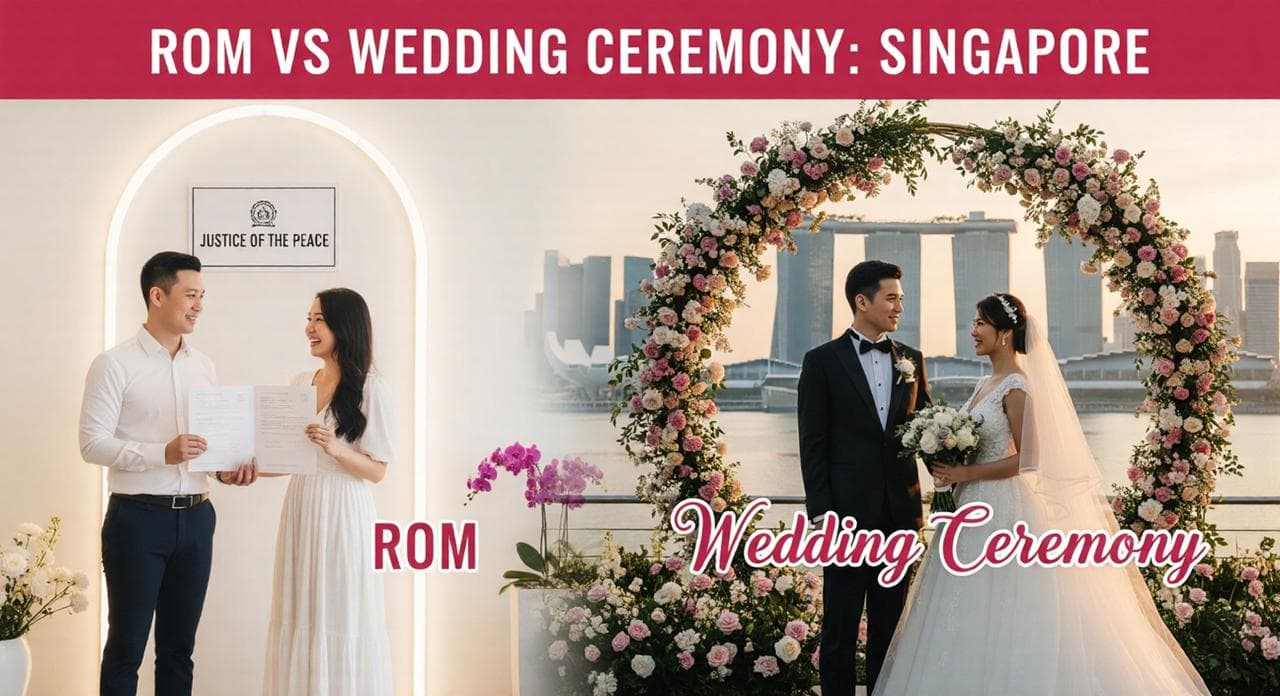
If you're newly engaged and starting to plan your wedding in Singapore, you've probably come across terms like ROM, solemnization, actual day, and wedding banquet — and wondered how they all fit together. Are they the same thing? Do you need all of them? Can you skip the big wedding and just ROM?
You're not alone. This is one of the most common questions Singapore couples ask, and the answer isn't as straightforward as you might think. Let's untangle everything.
What Exactly Is ROM?
ROM — the Registry of Marriages — is the government body under Singapore's Ministry of Social and Family Development that handles all civil (non-Muslim) marriages. To be legally married in Singapore, every couple must complete the ROM process: filing a Notice of Marriage (at least 21 days before the ceremony), attending a solemnization officiated by a licensed solemnizer, and having two witnesses sign the marriage certificate. The filing fee is S$42 for Singapore Citizens or PRs (source: ROM.gov.sg).
When people say "we're going to ROM," they usually mean they're getting their marriage legally registered and solemnized through the civil process.
Here's the key thing to understand: your marriage is only legally valid once it's been solemnized by a licensed solemnizer and registered with ROM. No matter how grand your wedding banquet is, without this step, you're not legally married in the eyes of Singapore law.
The ROM process involves:
- Filing a Notice of Marriage online (at least 21 days before your ceremony)
- Completing verification and a statutory declaration
- Having a licensed solemnizer officiate your vows
- Two witnesses aged 21 or older
- Signing the marriage certificate
Cost: Just $42 if at least one party is a Singapore Citizen or PR. $380 if both are foreigners.
Where Is ROM Now?
If you're planning for 2026, take note — the ROM office has temporarily moved to Level 3, Esplanade Mall while the iconic Canning Rise building undergoes redevelopment (expected until 2028). Everything still functions the same way, just a different location. You can still choose to solemnize at the ROM office or at an external venue of your choice.
What Is a Wedding Ceremony?
A "wedding ceremony" in Singapore can mean a few different things depending on your cultural background:
- Solemnization ceremony — The legal bit where vows are exchanged and the marriage certificate is signed. This IS the ROM process (or ROMM for Muslim marriages).
- Church/temple/mosque ceremony — A religious ceremony that may or may not double as the legal solemnization.
- Traditional customs — Chinese tea ceremony, Malay bersanding, Indian thali tying, etc. These are culturally significant but not legally binding on their own.
- Wedding banquet/reception — The dinner celebration with family and friends. Again, culturally important but not a legal requirement.
So when we talk about "ROM vs wedding ceremony," we're really asking: do you need the full works, or can you keep it simple?
ROM-Only vs Full Wedding: What's the Difference?
Let's break it down side by side.
| ROM-Only | Full Wedding | |
|---|---|---|
| Legal status | Legally married ✅ | Legally married ✅ (solemnization included) |
| Typical cost | $42 + photographer (~$500–$1,500) | $30,000–$80,000+ |
| Guest count | 2 witnesses minimum, up to ~20 | 100–500+ |
| Duration | 15–30 minutes | Full day or weekend |
| Planning time | 1–3 months | 6–18 months |
| Customs included | Optional | Tea ceremony, gate crash, etc. |
| Banquet | No (maybe a small dinner) | Yes, typically hotel/restaurant |
The bottom line? ROM is the only legally required part. Everything else — the banquet, the gown, the 28-table dinner — is tradition and celebration, not a legal necessity.
Can You Just ROM Without a Wedding?
Absolutely. And more Singapore couples are doing exactly that.
There's a growing trend of couples who choose to "just ROM" — keeping things intimate with close family and friends, skipping the big banquet, and channelling their savings into their home, honeymoon, or future plans. It's completely valid and increasingly common.
Here's what a ROM-only celebration might look like:
- Solemnization at ROM office or a small external venue (a café, restaurant, or even at home)
- Intimate lunch or dinner with both families — maybe 10–20 people
- Simple photo session — some couples hire a photographer for just 1–2 hours
- Total cost: $1,000–$5,000 (a fraction of a full wedding)
Why Couples Choose ROM-Only
- Budget-conscious — Rather spend on BTO renovation than a 3-hour banquet
- Introverted — Not everyone wants to be the centre of attention for 500 people
- Practical — Some couples have been living together for years and feel the formality is enough
- Second marriages — Less pressure for a grand affair
- Different priorities — Prefer to invest in experiences (travel, home) over one event
The Pressure to Have a "Proper Wedding"
Let's be real — in Singapore, there can be significant family pressure to throw a banquet. Parents may feel it's important for "face" (面子), or relatives expect the traditional customs. If you're leaning ROM-only, here are some tips for navigating the conversation:
- Have the talk early — Don't spring it on your parents last minute
- Acknowledge their feelings — "We understand this is important to you"
- Offer a compromise — A small family dinner or intimate celebration can go a long way
- Frame it positively — "We want to put our savings toward building our home together"
- Remind them it's legal either way — Some older relatives genuinely worry you're "not properly married" without a banquet
Same Day or Separate Days?
If you're doing both a solemnization and a wedding banquet, the next big question is: same day or different days?
Option 1: ROM and Banquet on the Same Day (Actual Day)
This is the most traditional approach. Your solemnization happens earlier in the day (often in the afternoon), followed by cocktails and the dinner banquet in the evening.
Pros:
- Everything happens in one go — guests only need to turn up once
- More cost-efficient (one venue, one day of vendors)
- Feels like a complete celebration
Cons:
- The day is LONG and exhausting (some actual days run 7 AM to midnight)
- Tight timeline — if the gate crash runs late, everything cascades
- Less time to enjoy the solemnization moment itself
- Your solemnization may feel "rushed" between other events
Option 2: ROM First, Banquet Later
Increasingly popular in Singapore. You do your solemnization weeks or even months before the big wedding banquet.
Pros:
- Solemnization gets its own spotlight — more intimate, more meaningful
- Less stressful on the actual wedding day (already legally married!)
- Flexibility to do your ROM somewhere special without banquet logistics
- You can technically be "married" sooner for BTO, housing, or admin purposes
Cons:
- Two events to plan and coordinate
- Guests may need to attend twice (though ROM is usually just close family)
- Some feel it "takes away" from the actual day
Pro tip: Many couples do their ROM 1–3 months before the banquet. This lets you enjoy each event fully and gives you a head start on changing your legal status for housing applications and other admin.
What About Religious Ceremonies?
Singapore is beautifully multicultural, and religious ceremonies add another layer to the ROM-vs-wedding discussion.
Christian Weddings
A church wedding can double as your legal solemnization — your pastor or minister can be a licensed solemnizer. So if you're having a church ceremony, you may not need a separate trip to ROM at all. Just make sure your officiant is registered with ROM.
Muslim Marriages
Muslim marriages in Singapore are registered through ROMM (Registry of Muslim Marriages), not ROM. The nikah ceremony itself serves as the legal marriage registration. ROMM has also relocated to Esplanade Mall alongside ROM during the redevelopment period.
Hindu & Buddhist Ceremonies
Temple ceremonies are culturally significant but are not automatically legal solemnizations. You'll need a separately registered solemnizer or to complete the ROM process in addition to your religious ceremony.
Interfaith Couples
If you're an interfaith couple, you'll go through the civil ROM process. You can still incorporate elements from both traditions into your celebration — many couples do a blend of customs that honour both families.
The ROM Process Step by Step (2026)
Whether you're doing ROM-only or ROM before a bigger wedding, here's how the process works:
Step 1: File Your Notice of Marriage
Head to marriage.gov.sg and submit your application via Singpass. You can file up to 6 months in advance but must give at least 21 days' notice.
Step 2: Verification & Statutory Declaration
ROM will schedule your verification — many couples can now complete this online. If required in person, head to the interim ROM office at Esplanade Mall. Bring your NRIC (or passport for foreigners), and any relevant documents (divorce papers, death certificate of former spouse, parental consent if under 21).
Step 3: Choose Your Venue and Solemnizer
You can solemnize at the ROM office for a simple ceremony, or choose any external venue with a licensed solemnizer. Check ROM's online directory to find registered solemnizers — this includes Justices of the Peace and religious leaders.
Step 4: The Big Moment
On your ceremony day, bring your ICs, your two witnesses, and your nerves. The solemnizer will verify identities, take your verbal consent, officiate the vows, and everyone signs. It takes about 15–30 minutes. After that — congratulations, you're legally married!
Step 5: Marriage Certificate
A digital marriage certificate is issued after solemnization. You can print copies for your own records or for that cute signing table photo.
Cost Comparison: ROM-Only vs Full Wedding
Here's a realistic breakdown for Singapore in 2026:
ROM-Only (~$1,500–$5,000)
- Marriage application: $42
- Solemnizer fee (external): $150–$500
- Small venue rental: $500–$2,000
- Photographer (2 hours): $500–$1,500
- Simple floral arrangement: $200–$500
- Intimate dinner for 10–20 pax: $500–$2,000
Full Wedding ($30,000–$80,000+)
- Everything above, plus:
- Wedding banquet (20 tables): $20,000–$50,000
- Bridal package (gown, suit, makeup): $3,000–$8,000
- Full-day photography + videography: $3,000–$6,000
- Décor and florals: $2,000–$8,000
- Wedding favours, ang bao boxes, invitations: $500–$2,000
- Bridal car, emcee, live band: $1,500–$5,000
The difference is stark. A ROM-only celebration can cost 95% less than a full wedding — which is why it's such an attractive option for couples who'd rather invest in their future together.
Making Your ROM Special (Even Without a Big Wedding)
Choosing ROM-only doesn't mean it has to feel like a trip to the government office. Here are ways to make it memorable:
- Pick a meaningful venue — A rooftop restaurant overlooking the skyline, a garden at Fort Canning, your parents' home, or a cosy café you both love
- Dress up (a little) — You don't need a full ball gown, but a nice dress or suit makes it feel special
- Hire a photographer — Even just for an hour. You'll want these photos
- Write personal vows — The solemnizer handles the legal bits, but you can add your own words
- Celebrate after — A nice dinner, champagne at home, or a weekend getaway makes the day feel complete
- Involve your parents — Even a small gesture like having them present means the world
So, What Should You Do?
There's no right answer — only what's right for you and your partner. Here's a quick decision framework:
Go ROM-only if:
- You prefer intimacy over grandeur
- Budget is a priority (hello, BTO renovation)
- You're not fans of being the centre of attention
- Both families are supportive of a simpler celebration
Do a full wedding if:
- You've always dreamed of a big celebration
- Family expectations are strong (and you're happy to honour them)
- You want the full experience — customs, banquet, the works
- Your ang bao collection will meaningfully offset costs
Do both (ROM first, wedding later) if:
- You want the best of both worlds
- You need to be legally married sooner (for housing, PR, etc.)
- You want each event to have its own moment
- You prefer spreading out the planning stress
Whatever you choose, remember: the marriage is what matters, not the wedding. Whether you say "I do" in front of 2 witnesses at ROM or 500 guests at a hotel ballroom, the commitment is exactly the same.
Planning your wedding in Singapore? Browse our complete wedding planning checklist for a step-by-step timeline, check out solemnization venues if you're looking for the perfect spot for your ROM ceremony, or review our wedding cost breakdown to budget for both events.
Related Guides
- Solemnization Venues in Singapore — Best spots for your ROM ceremony.
- Complete Wedding Planning Checklist — Full month-by-month timeline.
- How Much Does a Wedding Cost in Singapore? — Budget for both events.
- Best Wedding Venues Singapore 2026 — For when you're ready to book the banquet.
Compare Wedding Venues & Packages
115 venues, 396 packages — filter by budget, region, and capacity
Related Guides
Wedding Budget Template Singapore 2026: Complete Cost Breakdown by Tier ($20K / $50K / $80K)
Plan your Singapore wedding with confidence. Realistic cost breakdowns, budget templates for every tier, ang bao offsets, and money-saving tips for 2026.
Hidden Wedding Costs Singapore 2026: The Sneaky Charges That Blow Your Budget (And How to Avoid Them)
Service charge, overtime, corkage, minimum guarantee — real hidden wedding costs in Singapore that couples wish they'd known. Full breakdown with SGD figures.
Questions to Ask Your Wedding Venue in Singapore: The Ultimate Checklist Before You Sign Anything
Don't book blind. These are the essential questions to ask your wedding venue in Singapore — covering food tasting, corkage, minimum guarantee, overtime, rain plans, and more.