Wedding Speech Guide Singapore: Tips, Templates & Examples (2026)
Nail your wedding speech with proven templates for best man, groom, and maid of honour. Includes bilingual tips for Singapore's multicultural weddings.
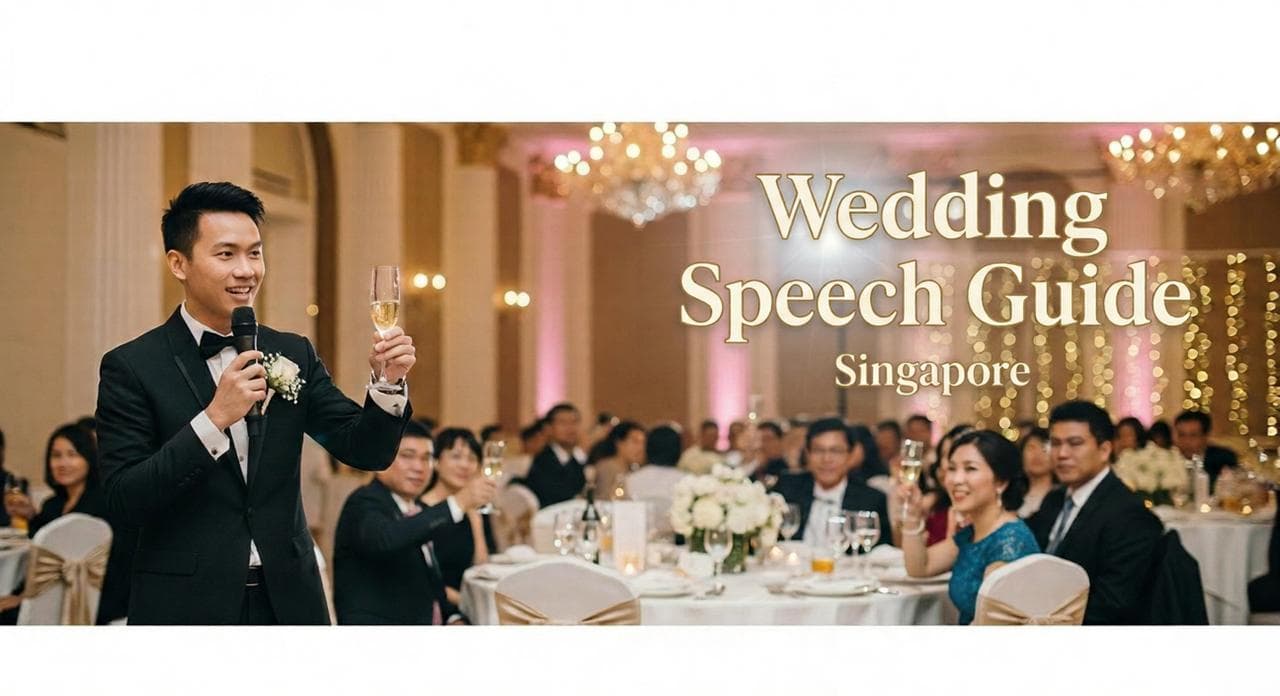
So You've Been Asked to Give a Wedding Speech
First of all — congratulations. Someone trusts you enough to hand you a microphone in front of 300 guests, their parents, and at least one table of very judgmental aunties. No pressure.
A Singapore wedding speech is a short address (typically 3–5 minutes) given by the groom, best man, maid of honour, or parents during the banquet reception — usually after the second march-in, during the cake-cutting segment or yam seng toast. Unlike Western receptions, most Singapore banquet speeches are shorter (3–5 minutes ideal, 8 minutes maximum), bilingual where possible, and delivered to a seated audience in the middle of a 10-course meal.
Whether you're the best man, maid of honour, groom, or parent of the couple, giving a wedding speech in Singapore comes with its own unique set of considerations. This isn't a Western cocktail reception with 40 guests — you're likely speaking at a Chinese banquet dinner with 20-30 tables, a bilingual emcee, and an 8-course meal that waits for no one.
But here's the good news: a great wedding speech doesn't require you to be a stand-up comedian or a TED Talk speaker. It just needs to be sincere, short, and well-timed. This guide will get you there.
Who Gives Speeches at Singapore Weddings?
Singapore wedding speeches follow a slightly different playbook from what you see in Western movies. Here's who typically speaks and when:
The Groom (and Sometimes the Bride)
This is the most common speech at Singapore weddings. The groom (or both partners) usually gives a thank-you speech during the second march-in — after the cake-cutting and champagne popping, and often right before the yam seng toast. It's essentially the centrepiece speech of the night.
Best Man
Less common at Singapore weddings than in Western ones, but increasingly popular — especially among younger couples. If you're asked to give a best man speech, it's usually slotted right after or before the couple's speech.
Maid of Honour / Bridesmaid
Same deal as the best man — not a given at every Singapore wedding, but a lovely touch when it happens. Often paired with the best man's speech as a set.
Parents
At Chinese banquets, the parents (usually the groom's father or a designated elder) may say a few words of thanks and blessing. This is often done in Mandarin or dialect and tends to be brief. At church weddings or Malay/Indian weddings, parents may play a bigger role in the programme.
The Emcee
Technically not a "speech" per se, but your emcee carries the evening. They'll do the introductions, transitions, and often the yam seng. If you're emceeing, you deserve your own guide (coming soon).
The Universal Speech Structure
No matter who you are, every good wedding speech follows the same three-part structure. Memorise this — it's your safety net.
1. Opening (30 seconds)
Introduce yourself and your relationship to the couple. Keep it warm and quick.
Key phrases to use:
- "For those who don't know me, I'm [name], and I've had the privilege of being [bride/groom]'s [relationship] for the past [X] years."
- "Good evening, uncles, aunties, friends, and family — thank you for being here tonight."
Pro tip: If the crowd is bilingual, open with a line in both languages. Even a simple "大家晚上好" (good evening everyone) before switching to English goes a long way.
2. The Story (2-3 minutes)
This is the heart of your speech. Share one or two stories that reveal something genuine about the person or the couple. Not a biography — a moment.
What makes a good story:
- It shows character (kindness, loyalty, humour)
- The audience can picture it happening
- It connects to why this couple works
- It's appropriate for all ages at the table (yes, all ages)
What does NOT make a good story:
- Anything involving exes (seriously, don't)
- Inside jokes nobody else gets
- That one night in Bangkok (you know which one)
- Anything that makes the parents flinch
3. The Toast (30 seconds)
Wrap it up with a heartfelt wish for the couple and raise your glass. This is where you land the plane.
Key phrases:
- "Please raise your glasses to [bride] and [groom] — to love, laughter, and happily ever after."
- "Here's to a lifetime of happiness, good food, and never-ending HDB renovations."
- If yam seng follows your speech, you can segue: "And with that, I'd like to invite everyone to join me in a toast — yam seng!"
Singapore-Specific Tips You Won't Find Elsewhere
Bilingual and Multilingual Considerations
Singapore weddings are almost always bilingual. Here's how to handle it:
- Split the languages between speakers. The most common approach: the groom speaks in English, the bride (or a parent) speaks in Mandarin. Or vice versa. Coordinate so you're not both doing the same language.
- You don't need to be fluent. If your Mandarin is rusty, even a few heartfelt lines in Chinese show effort. Write them out phonetically if you need to.
- For multi-cultural weddings (Chinese-Malay, Chinese-Indian, etc.), acknowledge both families warmly. A few words in the other family's language — even rehearsed — is incredibly touching.
- Avoid idioms that don't translate. "They complete each other" works in any language. "He finally found someone who'd put up with him" might not land the same way in Mandarin.
Keeping It Auntie-and-Uncle Friendly
Your audience at a Singapore banquet isn't just your JC clique. Table 1 has the grandparents. Table 18 has your colleagues. Table 25 has the groom's army mates. You need to work the full room.
- Keep it clean. Save the roast for the stag night. The banquet is not the place for "remember when he got so drunk that..."
- Avoid sensitive topics. Religion, politics, money (beyond the usual ang bao jokes), and anything that could embarrass the families. In multi-cultural settings, be extra mindful.
- Read the room. If it's a more traditional Chinese banquet with lots of older relatives, keep it respectful. If it's a younger, more casual crowd at a restaurant wedding, you have a bit more room to be cheeky.
Timing and Logistics
Banquet speeches happen at very specific moments in the programme. Get this wrong and you'll be competing with the chilli crab course.
- When speeches happen: Typically during or right after the second march-in (around courses 4-6). The emcee will introduce you — don't just grab the mic.
- How long: Aim for 3-5 minutes max. Singaporeans are polite, but after 7 minutes, people start checking their phones and eyeing the next dish.
- Mic check: If you're at a hotel ballroom, the AV team will have a wireless mic ready. At a restaurant, it might be a standing mic or — worst case — no mic at all. Confirm with the couple or wedding planner beforehand.
- Cue cards are fine. Nobody expects you to memorise a speech. A phone with notes or small cards in your hand is perfectly acceptable. Just don't read robotically — look up, make eye contact, breathe.
- Stand where people can see you. Usually on stage or next to the couple's table. Avoid speaking from your seat — you want the room's attention.
Speech Outlines by Role
Here are practical outlines you can adapt. Fill in your own stories and details — that's what makes it yours.
Best Man Speech Outline
- Open: Introduce yourself, how you know the groom. Quick, warm, maybe a little funny.
- Story #1: A story that shows the groom's character — loyalty, humour, heart. Something the room can relate to.
- The couple: When you first saw them together / when you knew this was different. What the bride brings out in him.
- To the bride: Welcome her to the "bro circle." Acknowledge she's clearly the better half (the room will love this).
- Toast: Heartfelt wish + raise glass. Keep it genuine.
Total time: 3-4 minutes.
Maid of Honour Speech Outline
- Open: Who you are, your history with the bride. Set a warm tone.
- Story #1: A defining moment with the bride — could be funny, could be moving. Ideally both.
- The couple: How the bride talks about the groom. The moment you knew he was the one for her.
- To the groom: A warm welcome. "Take care of her — but honestly, she can take care of herself."
- Toast: Wish them well, raise your glass, maybe dab a tear (it's allowed).
Total time: 3-4 minutes.
Groom's Thank-You Speech Outline
- Open: Thank everyone for coming. Acknowledge it's been a long day (especially for the bride).
- Thank the parents: Both sets. Be specific — "Thank you for [specific thing]." This is the part that makes the mums cry.
- Thank the bridal party and helpers: Brothers, sisters, wedding planner, emcee, whoever made the day happen.
- To your bride: This is your moment. Say what she means to you. You don't need poetry — sincerity beats Shakespeare every time.
- Toast / Yam Seng transition: Invite everyone to raise their glasses. If the yam seng is next, hand off to the emcee smoothly.
Total time: 4-5 minutes.
Parent's Speech Outline
- Welcome guests: Thank everyone for attending and celebrating.
- About your child: A brief, heartfelt reflection — watching them grow, a proud moment.
- Welcome the new family member: Warmly receive the son-in-law or daughter-in-law into the family.
- Blessing: A wish for their marriage. Can be religious, cultural, or simply from the heart.
Total time: 2-3 minutes. (Parents get a pass on brevity — if they go long, nobody minds.)
Common Mistakes to Avoid
- Going too long. The #1 sin. If your speech is over 5 minutes, cut it. Then cut it again. Nobody ever complained about a speech being too short.
- Too many inside jokes. One is fine if you explain it quickly. Three in a row and you've lost 90% of the room.
- Mentioning exes. Not even as a joke. Not even vaguely. Just don't.
- Getting too drunk before your speech. One drink for courage is fine. Four drinks and you're a liability.
- Winging it. "I'll just speak from the heart" is code for "I'll ramble for 10 minutes and forget the toast." Prepare. Practice. Please.
- Reading your entire speech off your phone without ever looking up. Eye contact is what turns words into a moment.
- Forgetting to actually toast. You'd be surprised. After all that buildup, some speakers just... sit down. Raise your glass. Say their names. Let the room join in.
- Making it about you. Your speech is about the couple. Your army stories, your career achievements, your love life — save them for your own wedding.
Practical Checklist Before the Big Day
- Written your speech (not just "thought about it")
- Practised out loud at least 3 times
- Timed it (3-5 minutes, no more)
- Confirmed your slot in the programme with the couple or emcee
- Checked if there's a mic and AV setup
- Coordinated language with other speakers (no two English speeches if half the room speaks Mandarin)
- Removed anything that could embarrass the couple or families
- Prepared cue cards or phone notes as backup
- Had one (1) drink for courage, not five
Frequently Asked Questions
How long should a wedding speech be in Singapore?
Aim for 3-5 minutes. At a banquet dinner with 8 courses, a packed programme, and 200+ guests, shorter is always better. The emcee, video montage, games, and yam seng all need airtime too. If you can say it in 3 minutes, don't stretch it to 7.
Should I give my speech in English or Mandarin (or another language)?
It depends on the audience. At most Singapore weddings, the couple will coordinate who speaks in which language. A common split: groom speaks in English, bride or parent speaks in Mandarin. If you're giving a best man or maid of honour speech, English is typically fine — but opening with a line or two in the other language shows respect and warms up the whole room.
Is it okay to use notes or read from my phone?
Absolutely. Even professional speakers use notes. The key is to not only look at your phone — glance at your notes, then deliver the line to the audience. Think of it as a conversation with occasional cheat sheets, not a dramatic reading of your Notes app.
Do I need to give a speech if I'm the best man or maid of honour?
Not necessarily. In Singapore, best man and maid of honour speeches aren't a mandatory tradition the way they are in Western weddings. Check with the couple — some want speeches, some prefer to keep the programme tight. If they haven't asked, don't assume. And if they do ask, take it as a compliment and use this guide.
What if I'm terrified of public speaking?
You're not alone — most people are. Here's the thing: nobody expects a polished performance. They expect sincerity. Write it out, practise until you're comfortable, keep it short, and remember that the audience is on your side. They want you to do well. And if your voice shakes a little? That just means you care. The room will love you for it.
Can I use humour in my speech?
Yes, but calibrate it. A warm, observational joke about the couple works great ("If you've ever seen James try to cook, you'll understand why Rachel is truly a saint"). Avoid sarcasm that might not land, roast-style burns, or anything that requires the disclaimer "but seriously though." When in doubt, go heartfelt over funny — a sincere speech always beats a comedy set that falls flat.
Final Thought
The best wedding speeches aren't the funniest or the most eloquent. They're the ones where you can tell the speaker genuinely loves the couple and took the time to say it well. In a room full of people who showed up with ang baos and empty stomachs, your job is simple: make them feel something, make the couple smile, and sit down before the shark's fin arrives.
You've got this. 🥂
Related Guides
- Best Wedding Venues in Singapore — different venues have different acoustics and AV setups that affect your speech delivery
- Best Wedding Bands and Musicians in Singapore — coordinate your speech timing with your emcee and live band for a smooth programme
- Wedding Planning Checklist & Timeline Singapore — where speeches fit in the banquet programme and who needs to know what
- Wedding Invitation Wording & Etiquette Singapore — getting the formalities right extends to the speech, not just the card
Compare Wedding Venues & Packages
115 venues, 396 packages — filter by budget, region, and capacity
Related Guides
Wedding Budget Template Singapore 2026: Complete Cost Breakdown by Tier ($20K / $50K / $80K)
Plan your Singapore wedding with confidence. Realistic cost breakdowns, budget templates for every tier, ang bao offsets, and money-saving tips for 2026.
Hidden Wedding Costs Singapore 2026: The Sneaky Charges That Blow Your Budget (And How to Avoid Them)
Service charge, overtime, corkage, minimum guarantee — real hidden wedding costs in Singapore that couples wish they'd known. Full breakdown with SGD figures.
Questions to Ask Your Wedding Venue in Singapore: The Ultimate Checklist Before You Sign Anything
Don't book blind. These are the essential questions to ask your wedding venue in Singapore — covering food tasting, corkage, minimum guarantee, overtime, rain plans, and more.