Chinese Tea Ceremony Guide Singapore: Everything You Need to Know (2026)
Complete guide to the Chinese wedding tea ceremony in Singapore — serving order, what to prepare, etiquette, dialect differences, and tips from real couples.
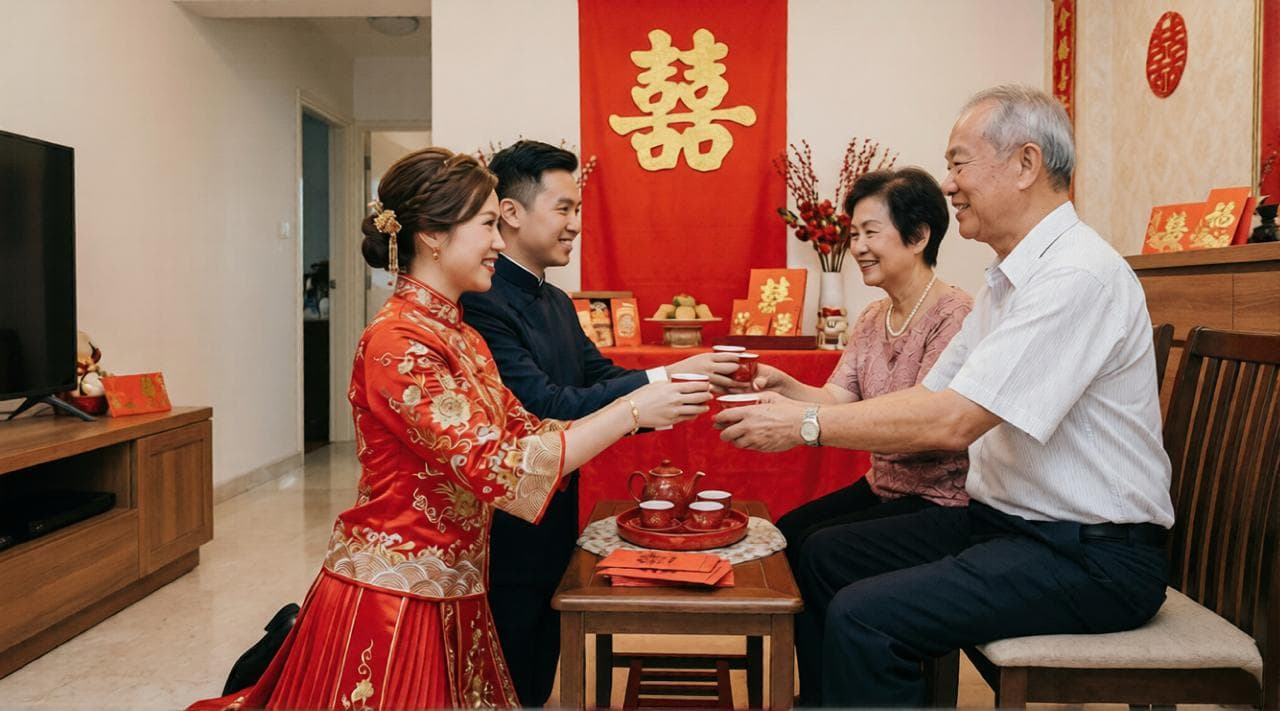
Of all the moments on your wedding day, the tea ceremony (敬茶, jìng chá) is the one that makes everyone cry — including the uncle who swore he wouldn't.
It's a beautifully simple tradition: you and your partner kneel before your elders, serve them tea, and receive their blessings in return. No grand stage, no elaborate choreography. Just two families becoming one over cups of sweet tea.
If you're planning a Chinese wedding in Singapore, the tea ceremony is likely non-negotiable — and honestly, you wouldn't want to skip it. Here's everything you need to know to get it right.
What the Tea Ceremony Actually Means
The Chinese wedding tea ceremony (敬茶, jìng chá) is a traditional ritual where the newlywed couple formally serves tea to their parents and elders, receiving blessings and red packets or gold jewellery in return. It's one of the most emotionally significant moments of a Chinese wedding in Singapore — typically lasting 30–60 minutes and involving both the bride's and groom's families. According to the Registry of Marriages, the majority of Singapore's approximately 27,000 annual marriage registrations involve Chinese couples, most of whom observe some form of the tea ceremony.
At its core, the tea ceremony is about gratitude and respect. You're formally acknowledging your elders, thanking them for raising you, and asking for their blessings as you start your new family.
When your elders accept the tea, they're welcoming your spouse into the family. When they hand over red packets or gold jewellery, they're passing on good fortune and giving their stamp of approval.
It's also your first official act as husband and wife — your first duty together. That's why so many couples say this was the moment they truly felt married.
When and Where to Hold It
Timing
Most Singapore couples hold the tea ceremony on the actual wedding day itself. The typical flow looks like this:
- Morning — Groom fetches the bride (with gatecrash games, of course)
- After gatecrash — Tea ceremony at the bride's home
- Head to groom's home — Tea ceremony at the groom's place
- Then off to the banquet venue
But there's flexibility here. Some couples hold it:
- Before the solemnisation
- Between solemnisation and reception
- During the banquet itself
- On a completely separate day
Venue Options
- Family home — The most traditional (and sentimental) option. Your HDB flat or condo living room works perfectly fine.
- Wedding venue — Many modern couples do both families' tea ceremonies back-to-back at the hotel or restaurant. Saves a ton of travel time.
- Separately rented space — Heritage shophouses or hotel function rooms for a more curated vibe.
Whatever you choose, just make sure both families are aligned. The last thing you want is a scheduling tug-of-war on the morning of your wedding.
The Serving Order (This Is Important)
Getting the order right matters. It's a hierarchy thing — serve the most senior family members first, then work your way down.
Here's the standard serving order for most Chinese families in Singapore:
| Order | Who | What Happens |
|---|---|---|
| 1 | Paternal grandparents | You serve them tea |
| 2 | Maternal grandparents | You serve them tea |
| 3 | Parents (father, then mother) | You serve them tea |
| 4 | Uncles and aunties (by seniority) | You serve them tea |
| 5 | Elder siblings and their spouses | You serve them tea |
| 6 | Elder cousins (if included) | You serve them tea |
| 7 | Younger siblings | They serve you tea |
| 8 | Younger married cousins | They serve you tea |
Pro tip: Print out the full list with names and titles. Tape it somewhere you can glance at. In the moment, your brain will go blank — we've all been there.
Dialect Group Differences
Here's where it gets interesting. The exact order can vary depending on your dialect group:
- Hokkien — Generally follows the standard order above. Groom's family is typically served first.
- Teochew — Some families serve the bride's parents before the groom's, which is the reverse of the usual convention.
- Cantonese — Often the most elaborate setup, with a dedicated Dai Kum Jie (大妗姐) — a ceremony coordinator — running the show.
- Hakka — Tends to be more relaxed and less formal, but the core order remains the same.
When in doubt, ask your parents. They'll know their family's specific customs — and they'll appreciate you asking.
What You Need to Prepare
The Essentials Checklist
- Tea set — Traditional red porcelain with the Double Happiness (囍) symbol is classic. You can find sets at shops like Chang Jiu, Kek Hoon, or Eternal Red Bonds in Singapore. Budget around $30–$150 for a decent set (or much more for premium ones).
- Tea ingredients — The classic brew is sweet tea made with red dates (红枣), dried longan (龙眼), and lotus seeds (莲子). Each ingredient is symbolic: red dates for fertility, longan for togetherness, lotus seeds for abundance.
- Kneeling cushions — Red cushions for the couple to kneel on. Some modern families skip the kneeling and just have the couple stand or sit.
- Serving tray — A red tray to present the tea cups on.
- Red cloth — For the tea table setup.
- Spare cups — Disposable red cups as backups (many venues actually require these for hygiene reasons).
- Tissues and hand towels — Trust us, you'll need them. For tears and spills.
- Ang bao box — A nice box or pouch to collect all the red packets you'll receive.
What About the Tea Itself?
Brew it in advance and keep it warm — not scalding hot. Nobody wants to burn Ah Ma's lips. Lukewarm to warm is the sweet spot.
Have a helper stationed nearby to refill the teapot and rinse cups between servings. This is a great job for a bridesmaid or a younger cousin who wants to feel involved.
What to Wear
For the bride, a traditional Qun Kua (裙褂) or cheongsam/qipao is the classic choice. The Qun Kua is a heavily embroidered red and gold two-piece outfit — stunning in photos, though be warned: some are very warm to wear.
A modern cheongsam works beautifully too, especially if your tea ceremony is part of a longer wedding day and you need something easier to move in.
For the groom, a changshan (长衫) or a suit with a red tie/pocket square is standard. Some grooms opt for a matching traditional outfit with the bride.
Practical note: If you're kneeling, make sure your outfit allows it. Test this during your fitting. Nothing kills the mood like hearing a seam rip.
Key Phrases to Know
You don't need to give a speech, but you do need to address each elder correctly and say the right words. Here are the essentials:
- 请喝茶 (qǐng hē chá) — "Please drink the tea." This is the main phrase you'll say as you serve.
- 爸爸/妈妈,请喝茶 — "Dad/Mum, please drink the tea."
Address each elder by their proper Chinese title (大伯, 二叔, 阿姨, etc.). If you're not sure of the titles, ask your parents well in advance and practise. This is the one part of the ceremony that can get awkward if you fumble.
Common Blessings You'll Hear Back
Your elders will respond with blessings like:
- 百年好合 (bǎi nián hǎo hé) — "A hundred years of harmony"
- 早生贵子 (zǎo shēng guì zǐ) — "May you have children soon" (brace yourself for this one 😅)
- 幸福美满 (xìng fú měi mǎn) — "Happiness and fulfilment"
Ang Bao Etiquette
During the tea ceremony, elders will present you with red packets (ang bao) or gold jewellery after drinking the tea. A few things to note:
- Always receive with both hands. This is basic Chinese etiquette but easy to forget in the moment.
- Don't open them during the ceremony. Just accept, say thank you, and place them in your ang bao box.
- Parents and grandparents typically give the most generous amounts, sometimes accompanied by gold jewellery (bracelets, necklaces, rings).
- For younger relatives who serve you tea, prepare small red packets in return — $8, $18, or $28 are common amounts (even numbers ending in 8 are auspicious).
Timeline: How to Plan It All
4–6 Weeks Before
- Confirm date, time, and location with both families
- Purchase or borrow a tea set
- Buy tea ingredients (red dates, longan, lotus seeds — available at any provision shop or NTUC)
- Get kneeling cushions and a red tablecloth
1–2 Weeks Before
- Finalise the serving order with names and titles (print it out!)
- Assign helpers: one for refilling tea, one for passing cups, one for collecting gifts
- Prepare red packets for younger relatives
- Do a quick rehearsal of the kneeling, serving, and addressing
On the Day
- Brew tea about 30 minutes before the ceremony
- Set up the tea table with red cloth, cushions, and the tea set
- Brief your photographer — they need to know the order too
- Keep tissues within arm's reach
- Take a deep breath and enjoy it
Modern Twists That Work
Not every couple follows the traditional format to the letter, and that's totally fine. Here are some modern adaptations Singapore couples are embracing:
- Standing instead of kneeling — Especially if grandparents have mobility issues and insist you don't need to kneel
- Combined venue — Both families' ceremonies at the banquet venue, one after another
- Bilingual ceremony — If one partner isn't Chinese, having a family member explain each step in English makes everyone feel included
- Personalised tea blends — Some couples create custom tea blends as a modern touch (and double as wedding favours)
Common Mistakes to Avoid
- Not confirming the serving order in advance — This leads to awkward "who's next?" moments. Write. It. Down.
- Tea that's too hot — Elders will struggle to drink it. Aim for warm, not piping hot.
- Forgetting spare cups — You'll go through more cups than you think, especially with a big family.
- Rushing through it — This isn't a speedrun. Pause, make eye contact, and let each moment breathe. These are the memories you'll treasure.
- No assigned photographer — The ceremony moves fast. Make sure your photographer knows the order and is in position.
Final Thoughts
The tea ceremony is one of those rare wedding moments where everything slows down. No music, no emcee, no grand entrance — just you, your partner, and the people who've loved you your whole life.
It's okay if you stumble over a title. It's okay if the tea spills. It's okay if you ugly-cry in front of everyone (you probably will). What matters is showing up, being present, and letting your family know they matter to you.
So brew the tea, kneel down, and let the blessings flow. You've got this. 🍵
Related Guides
- Guo Da Li (过大礼) Guide Singapore — the betrothal ceremony that traditionally precedes your wedding and tea ceremony
- Auspicious Wedding Dates in Singapore — picking a date that's favourable for both the ceremony and the tea ceremony
- Wedding Planning Checklist & Timeline Singapore — where the tea ceremony fits in your full wedding day timeline
- Malay Wedding Customs and Traditions — how Malay wedding blessings compare to the Chinese tea ceremony tradition
Compare Wedding Venues & Packages
115 venues, 396 packages — filter by budget, region, and capacity
Related Guides
Wedding Budget Template Singapore 2026: Complete Cost Breakdown by Tier ($20K / $50K / $80K)
Plan your Singapore wedding with confidence. Realistic cost breakdowns, budget templates for every tier, ang bao offsets, and money-saving tips for 2026.
Hidden Wedding Costs Singapore 2026: The Sneaky Charges That Blow Your Budget (And How to Avoid Them)
Service charge, overtime, corkage, minimum guarantee — real hidden wedding costs in Singapore that couples wish they'd known. Full breakdown with SGD figures.
Questions to Ask Your Wedding Venue in Singapore: The Ultimate Checklist Before You Sign Anything
Don't book blind. These are the essential questions to ask your wedding venue in Singapore — covering food tasting, corkage, minimum guarantee, overtime, rain plans, and more.