Malay Wedding Customs and Traditions in Singapore: The Complete 2026 Guide
Everything you need to know about Malay wedding traditions in Singapore — from merisik and hantaran to akad nikah, bersanding, and budgeting tips for 2026.
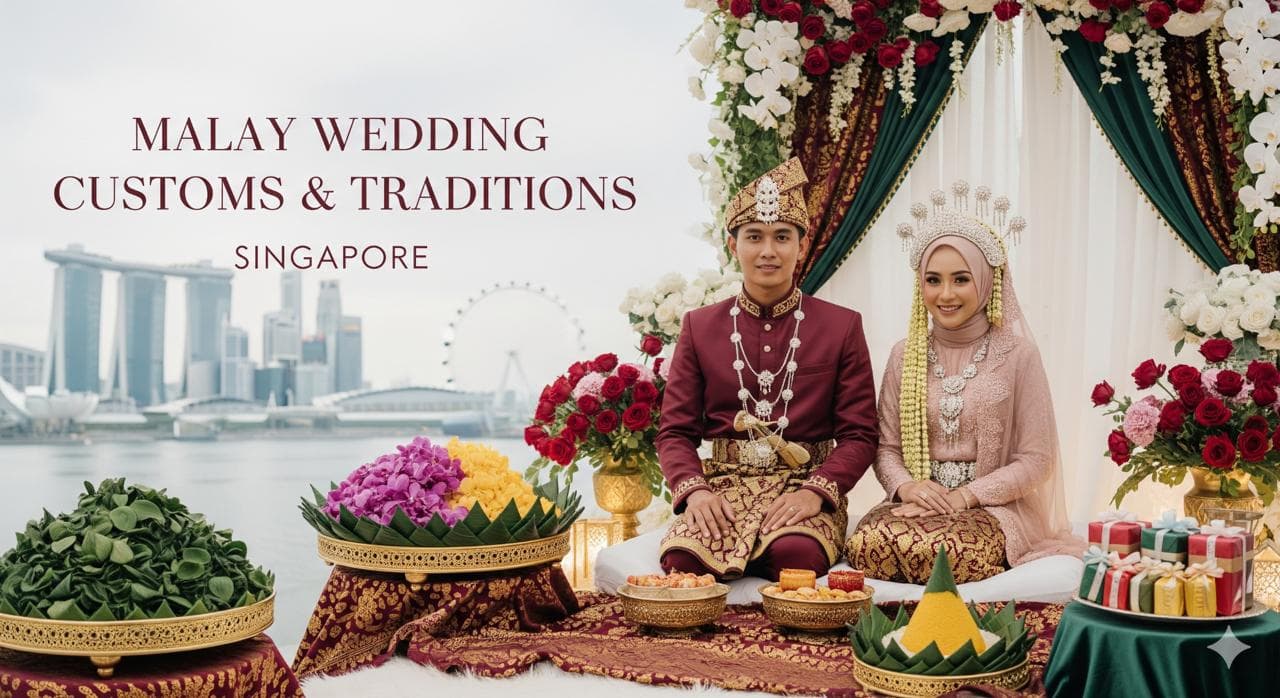
There's something truly magical about walking past an HDB void deck on a Saturday afternoon and being hit by the rhythmic beat of kompang drums, the rich aroma of nasi briyani, and the sight of a couple seated like royalty on an ornately decorated pelamin. If you've lived in Singapore long enough, you've experienced this — and if you're planning your own Malay wedding, you know how special (and complex) these celebrations can be.
Malay weddings in Singapore are a beautiful blend of Islamic religious obligations and Malay cultural traditions that have evolved over generations. Whether you're a couple planning your big day, a guest attending your first Malay wedding, or just curious about the customs, this guide covers everything you need to know.
The Key Ceremonies: A Quick Overview
A Malay wedding in Singapore is a culturally rich celebration combining Islamic religious obligations (such as the akad nikah solemnization) with Malay customs (like bersanding, merisik, and hantaran gift exchange). Malay Muslims make up approximately 13% of Singapore's population (source: Department of Statistics Singapore), and their weddings — often held at HDB void decks or community halls — typically accommodate 300–1,000 guests over one or two days. Budgets commonly range from S$15,000 to S$50,000 depending on scale and hantaran value.
A traditional Malay wedding in Singapore isn't just one event — it's a series of meaningful ceremonies that can span several days. Here's the typical flow:
- Merisik — the informal "investigation" visit
- Adat Bertunang — the engagement ceremony
- Hantaran — exchange of customary gifts
- Malam Berinai — henna night
- Akad Nikah — the solemnisation (the big one!)
- Bersanding — the wedding reception
Let's break each one down.
Merisik: The First Step
Before anything official happens, the groom's family sends representatives — usually respected elders — to visit the bride's family. Traditionally, this was quite literally an investigation to assess whether the couple would be a good match.
These days, since most couples already know each other (and have probably been dating for years), merisik is more of a formal introduction between families. It's the moment where both sides sit down to discuss compatibility, expectations, and whether to move forward with an engagement.
Think of it as the "let's make this official" conversation — respectful, warm, and often over a spread of kuih and tea.
Adat Bertunang: The Engagement Ceremony
Once both families agree, the engagement ceremony takes place at the bride's home. The groom's family arrives bearing gifts — typically an engagement ring (placed on the bride's finger by the groom's mother) and trays of beautifully arranged presents.
This is where the important details get ironed out:
- The wedding date — when will the akad nikah take place?
- Duit hantaran — the monetary gift from the groom to the bride's family
- Number of hantaran trays — always in odd numbers (7, 9, 11)
- How long the engagement period will last before the solemnisation
Interestingly, the groom traditionally doesn't attend this ceremony — he waits elsewhere while his family handles the negotiations. But modern couples increasingly prefer to be present, and honestly, why not? It's your wedding.
Hantaran vs Mas Kahwin: Know the Difference
This one trips up a lot of people, so let's clear it up.
Mas kahwin (dowry) is compulsory in Islam. It's a gift from the groom directly to the bride, symbolising his commitment to providing for her. The current minimum rate for mas kahwin in Singapore is $100, though many couples go higher as a personal gesture.
Hantaran (customary gifts) is a Malay cultural tradition — not a religious requirement. It's a monetary gift from the groom to the bride's family, and the amount varies widely. There's no fixed rule, but it's typically discussed and agreed upon during the engagement.
The hantaran exchange itself is a visual feast. Both families prepare elaborate trays — think designer bags, perfumes, shoes, jewellery, chocolates, and even gadgets — all meticulously arranged and decorated. The bride's family returns the same number of trays to the groom's family. If you've ever scrolled through Instagram hashtags like #hantaranSG, you'll know just how creative people get with these displays.
Malam Berinai: Henna Night
A few days before the wedding, the bride gathers her closest girlfriends and female relatives for the malam berinai — essentially the Malay version of a hen's night, minus the clubbing.
Instead, everyone gets intricate henna designs painted on their hands and feet. The bride's design is always the most elaborate, and there's real meaning behind it: the patterns are believed to ward off negative energy and bring blessings to the marriage.
Family and friends also paint the couple's fingertips with a yellowish oil (inai), symbolising their union. Some families keep it intimate and simple, while others turn it into a full-blown celebration with singing, dancing, and mountains of food. There are actually three traditional ceremonies — berinai curi (a small, "secret" one by bridesmaids), berinai kecil (before the nikah), and berinai besar (after the nikah) — though many modern families combine or simplify these.
Akad Nikah: The Solemnisation
This is the heart of the entire wedding — the moment the marriage becomes official in the eyes of God and the law.
The akad nikah can take place at a mosque, the bride's home, or the reception venue. For the ceremony to proceed, you need:
- A wali (the bride's guardian — usually her father, grandfather, or brother)
- Two male witnesses
- The mas kahwin (dowry)
- A kadi (the solemniser, officially appointed by ROMM — the Registry of Muslim Marriages)
Here's how it unfolds: the kadi first speaks privately with the bride (who is traditionally seated in a separate room) to confirm she consents to the marriage of her own free will. He then guides the groom through his marital vows, speaking to him about his duties as a husband.
The groom recites the marriage vows, and the kadi asks the witnesses and those present if they accept. If there are no objections — and there never are, because this isn't a movie — the couple signs the marriage contract, sealed with the mas kahwin.
Pro tip: Register your marriage with ROMM beforehand. The registration fee is $39, and it's customary to prepare a token of appreciation for the tok kadi of around $80–$100 to cover their time and transport.
The akad nikah usually takes place in the morning, either on the same day as the reception or a day or two before. Either way, bring tissues — this one gets emotional.
Bersanding: The Grand Reception
Now the party really begins. The bersanding is the public celebration of the marriage — a lively, open-house affair that's equal parts ceremony, feast, and community gathering.
The Kompang Procession
As the groom makes his way to the venue, he's escorted by a procession of kompang drummers singing verses seeking blessings for the couple. Walking alongside him are friends and relatives carrying bunga manggar — tall bamboo poles topped with colourful tinsel palm blossoms that symbolise fertility and prosperity. Placed outside the venue, they also double as "you've found the right void deck" markers.
The Hadang (Gate-Crashing)
Before the groom reaches his bride, he has to get through the hadang — a playful "blockade" by the bride's friends and family. Think of it as the Malay equivalent of Chinese wedding gate-crashing games. The groom might need to answer questions, perform tasks, or simply charm his way through. It's all in good fun and gets everyone laughing.
The Pelamin
Once the groom makes it through, the couple takes their place on the pelamin — an elaborately decorated dais where they sit like king and queen for the rest of the celebration. This is the centrepiece of the bersanding, and modern pelamin designs range from traditional gold-and-crimson setups to minimalist floral arrangements.
Guests come up to bless the couple by sprinkling scented water, rice, and bunga rampai (flower petals) over their hands — a beautiful communal blessing.
Silat Pengantin
Some weddings feature a silat pengantin performance — an elegant, choreographed adaptation of the traditional Malay martial art. It's graceful, symbolic, and genuinely impressive to watch.
The Food
Let's be honest — you're here for the food. Malay wedding buffets are legendary. Expect nasi briyani, rendang, satay, ayam masak merah, kuih-muih, and more than you could possibly eat in one sitting. The open-house format means guests come and go throughout the event, so there's always a fresh crowd at the buffet table.
Venue Options and Budget Guide for 2026
One of the biggest decisions you'll make is where to hold your celebrations. Here's a realistic breakdown:
HDB Void Deck
- Cost: From $70 for the space rental
- Vibe: Communal, kampung spirit, open-air
- Best for: Large guest lists, budget-conscious couples, families who value the gotong royong tradition
- Note: You'll need to separately arrange catering, furniture, tentage, AV equipment, and décor
Community Centre / Multi-Purpose Hall
- Cost: $200–$800
- Vibe: Sheltered, slightly more formal
- Best for: Couples who want affordability with a roof over their heads
Mosque
- Cost: $500–$2,200 depending on location and package
- Best for: Akad nikah ceremonies (some offer limited seating and 2-hour slots)
Hotel Ballroom / Dedicated Wedding Venue
- Cost: $8,000–$15,000+ (often all-inclusive)
- Vibe: Air-conditioned, elegant, full-service
- Best for: Couples who want a hassle-free, premium experience
- Examples: Holiday Inn Singapore Atrium (from $148 nett per table for Malay packages), Royal Palm @ Orchid Country Club, Lagun Sari
Full Wedding Budget Estimates
| Budget Tier | Estimated Cost | What You Get |
|---|---|---|
| Budget | $5,000–$10,000 | Void deck, standard catering, simple pelamin, minimal entertainment |
| Mid-Range | $15,000–$30,000 | Function hall or CC, professional décor, kompang, photographer |
| Premium | $30,000–$50,000+ | Hotel ballroom, custom pelamin, live band, full wedding package |
Key Cost Breakdown
- Catering (200 guests): $4,000–$10,000 ($20–$50 per pax)
- Pelamin & décor: $3,000–$7,000+
- Kompang troupe: $500–$800
- Emcee: $500–$800
- DJ or live band: $1,000–$2,000
- Photography & videography: $1,500–$4,000
- Bridal makeup (mak andam): $800–$2,500
- ROMM registration: $39
- Tok kadi appreciation: $80–$100
What Guests Should Know
Attending your first Malay wedding? Here are some quick tips:
How Much Ang Bao to Give
- Void deck: $10–$30
- Function room / CC: $30–$50
- Hotel: $50 and above
There's no obligation to "cover your plate" like at Chinese weddings — it's about the spirit of giving. And there's no auspicious number to follow, so any amount is fine.
What to Wear
Good news: there are no unlucky colours at Malay weddings. Black, white, red — all perfectly fine. The main rule is to dress modestly, especially if the ceremony is at a mosque (cover shoulders and knees, and women should bring a shawl or tudung).
Wearing traditional Malay attire like baju kurung or baju melayu is always appreciated but not required. Smart casual works too — just skip the shorts and singlets.
Etiquette Tips
- Come and go freely — Malay weddings have an open-house format, so there's no strict arrival time
- Eat with your right hand if eating traditionally (though cutlery is always provided)
- Greet the couple at the pelamin if there's a blessing line
- Salam the elders — a gentle handshake followed by touching your heart shows respect
Modern Trends in 2026
Malay weddings in Singapore keep evolving while honouring their roots:
- Intimate nikah-only celebrations — Some couples skip the large bersanding entirely, opting for a meaningful nikah with close family followed by a small dinner
- Themed décor — From rustic botanicals to minimalist Japandi-inspired pelamin designs, couples are getting creative
- Destination solemnisations — Beach nikah ceremonies in Bintan or Batam are increasingly popular
- Digital invitations — E-cards via WhatsApp have become the norm, with some couples creating wedding websites
- Combined celebrations — Joint bersanding for both families (instead of separate receptions) is now more common, saving costs and simplifying logistics
Planning Timeline
Here's a suggested timeline to keep your planning on track:
- 12–18 months before: Merisik, engagement, book venue and major vendors
- 6–9 months before: Confirm hantaran details, book photographer, caterer, and pelamin vendor
- 3–6 months before: Register with ROMM, arrange kadi, finalise menu and décor
- 1–2 months before: Malam berinai, confirm all vendors, prepare hantaran trays
- 1 week before: Final venue walkthrough, reconfirm wali and witnesses
- The big day: Akad nikah → bersanding → celebrate!
Wrapping Up
A Malay wedding in Singapore is so much more than just a ceremony — it's a celebration of love, faith, family, and community. From the gentle formality of merisik to the joyous chaos of the bersanding, every tradition carries meaning that's been passed down through generations.
Whether you're planning a grand void deck affair with 500 guests or an intimate nikah at the mosque, the most important thing is that it reflects you as a couple. The customs are a beautiful framework, but at the end of the day, it's your love story.
Selamat pengantin baru — congratulations to the newlyweds! 🤍
Related Guides
- Indian Wedding Ceremony Guide Singapore — how Singapore's Indian wedding traditions compare to Malay celebrations
- Chinese Tea Ceremony Guide Singapore — the Chinese family blessing ceremony with fascinating parallels to Malay customs
- Best Wedding Venues in Singapore — hotel and community venues that offer dedicated Malay wedding packages
- Wedding Planning Checklist & Timeline Singapore — a 12-month countdown adaptable to multi-ceremony Malay weddings
Compare Wedding Venues & Packages
115 venues, 396 packages — filter by budget, region, and capacity
Related Guides
Wedding Budget Template Singapore 2026: Complete Cost Breakdown by Tier ($20K / $50K / $80K)
Plan your Singapore wedding with confidence. Realistic cost breakdowns, budget templates for every tier, ang bao offsets, and money-saving tips for 2026.
Hidden Wedding Costs Singapore 2026: The Sneaky Charges That Blow Your Budget (And How to Avoid Them)
Service charge, overtime, corkage, minimum guarantee — real hidden wedding costs in Singapore that couples wish they'd known. Full breakdown with SGD figures.
Questions to Ask Your Wedding Venue in Singapore: The Ultimate Checklist Before You Sign Anything
Don't book blind. These are the essential questions to ask your wedding venue in Singapore — covering food tasting, corkage, minimum guarantee, overtime, rain plans, and more.